
Poetry by
Don James
Don James was a Canadian poet, who was also my friend. Sadly, he passed away on February 4, 2015, at the age of 88. He wrote his plain-speaking poetry all his life.
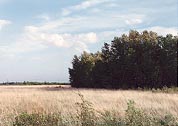
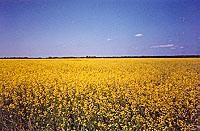
This is the southern part of Manitoba, where Don lived. The flatness of the landscape surely affected his poetry.
Above, and Clouds, at top: Having such a big sky can influence your thinking.
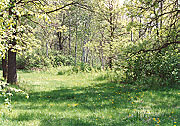
This is a glen in Manitoba, where Don lived.
Nancy Doyle
Fine Art

 | ||||||
Spring Chemistry
Tonight the rain is telling
rumors of roots in the restless earth
rhythms and subtle chemistry.
Tomorrow the sun will show
the transcript of the telling
in day detail.
But now the yeast is down
below the grasses and has started
talk of a green kingdom in the rain.
Emily Dickinson
baked good bread
and wrote great poems
during her stay in America -
and her bread won first prize
at the County Fair,
but nobody
prized her poems.
Emily Dickinson
wrote great poems
and baked good bread
during her stay in America -
and her bread was praised
in the state of Massachusetts,
but nobody
praised her poems
| ||||||
A BRIEF BIO
My biological mother got me here. My earth mother has kept me here.
Raised on a farm that is held firmly in the hand of the land, I have sat at the feet of my all-knowing earth mother, latching onto pointers she has been good enough to pass down to me.
To press the rewind button, after his first shave the impatient country boy eager to step out into that big world out there thought he was a man enough to do it. Wanted to find out what was going on beyond the boundaries of the quarter section set back in the bush.
The big world was out there all right, in full force; big, tough, could be mean. This was not quite what the inexperienced boy had bargained for. Fortunately, the kind old farm was still there, and my kind parents were understanding; and I crawled back to our quarter section set back in the bush with a secondhand set of the Encyclopedia Britannica; and I gobbled up the books; and it was a step from using all those wonderful words I read to expressing my own thoughts and feelings, and the good, satisfying feeling I got from that. And still do.
Did journalism, film scripts, anything to turn a buck; but it was the poetry that got to me once I got to it; working the words the way Nancy can work those colors once she loads up her brush and goes at a canvas.
It's a thing that gets to you, poetry, painting; what we pull out of head and heart and soul. The surprises we may come upon in there we didn't know we held. You're captured by this, and you're a captive for life, but only because you want to be. Because you need to be. And your captor is called art.

Earth as Poet
The earth scribbles poems continually
leaving them lie
wherever they happen to fall,
having too many poems to keep track of,
immediately starting another.
We who scribble poems on paper
do not write them so much as pick up
poems the earth has carelessly dropped,
leaving us to try to translate them
into a form of words.
Cortez
It would not have mattered if the Aztec sun
fierce as a God's face on fire
had been the color of mud or ashes:
the light that flooded the brain of the obsessed Spaniard
would have still been yellow.
Nor could the Aztec have known of the white man's foolishness
for pieces of the abundant sun that had broken off
and fallen to the earth,
nor would he have understood,
for the sun remained as large as ever.
How might the sophisticated Aztec have known, how suspected
the dangerous madness of the man called Cortez
for pieces of the yellow, abundant sun
that had broken off,
and fallen to the earth,
falling upon Mexico?
The Farmer Versus the Muse
I know some thorough farmers
but none of them are poets,
even though they live
intimately with Nature
(still the best mentor of thine rhyming beast)
and pass her seasons
through them, and know her moods
as well as the moods of their wives,
and live with her
as closely, as uncertainly,
and she's at the bottom of all their business,
and figures in all their calculations,
but they are not carried away by it,
and swept into verse by it,
but they always manage
to come through and keep their heads.
I suppose it's because farmers are always so busy,
so involved, working with the earth,
pulling out its intestines and putting them back,
performing rough surgery of all sorts,
patching earth up for another spring,
they haven't got time for its poetry;
but life's too practical an affair for them,
and had better be, if they are to eat,
and pay their arrears.
I suppose practical people just don't write this stuff,
and realists don't, and your successful farmer
is a realist, if he's anything,
and the few poets who tried farming,
like Robbie Burns and Bobby Frost
went broke.
A Bit of Autobiography
At five I was sent to school to improve my mind.
The teacher was
tall as a tree,
and I was
small as a shrub,
and when I stood before him
erect, defiant, brave,
I towered
to his very knees.
Now this teacher was from dark and distant Russia
and was once
a military man.
He had served
in the army of the Czar;
he had fled
Russia in his Russian motor car;
he had caught
a hurried ship for Canada,
and he trickled down at last
into the placid hamlet of Lydiatt, Manitoba,
and into my little life.
My teacher 'tis of thee I sing!
You were still so militarily severe
with your head in the shape of a bullet,
we grew smaller in our seats when you scowled,
smaller and smaller,
while you, conversely,
grew taller and taller.
Then a most curious thing began to happen
with the passing of the curious years:
As I grew taller and taller,
my teacher grew smaller and smaller,
until I was as tall as he was,
and he was as small as I was,
and the difference between us
was no longer one of vertical extent.
The moral of this tender reminiscence
(if you want one)
is: Keep on growing.
